Insmed (INSM): From Clinical Breakthrough to Commercial Breakout
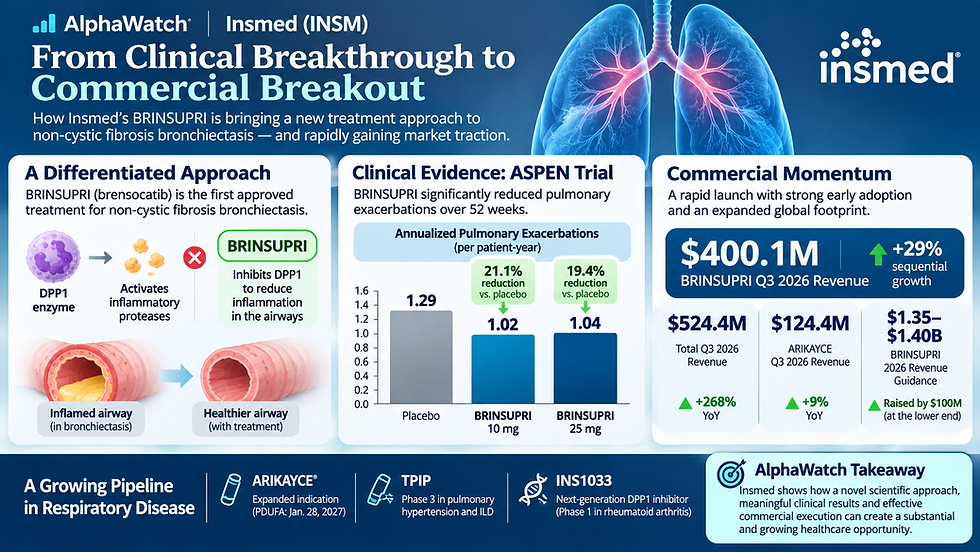
What happens when a biotechnology company develops the first approved treatment for a disease that has historically lacked targeted therapeutic options?
Insmed (INSM) is providing a compelling example.
In August 2025, the FDA approved BRINSUPRI (brensocatib), the first approved treatment specifically for non-cystic fibrosis bronchiectasis, a chronic lung disease characterized by damaged airways, persistent inflammation and recurrent respiratory exacerbations.
For patients, these exacerbations can mean worsening respiratory symptoms, additional antibiotic treatment and disruptions to daily life.
For years, treatment largely focused on managing infections, clearing mucus and controlling symptoms.
Insmed approached the disease differently.
Non-cystic fibrosis bronchiectasis is a chronic lung disease in which damaged, widened airways struggle to clear mucus. This can create a cycle of infection, inflammation and further airway injury.
BRINSUPRI is a once-daily oral inhibitor of dipeptidyl peptidase 1 (DPP1). By inhibiting DPP1, the drug reduces activation of neutrophil serine proteases—enzymes that contribute to inflammatory damage in the airways.
Unlike antibiotics, which target infections, BRINSUPRI addresses an inflammatory pathway involved in the disease process.
The clinical evidence established the foundation.
In the pivotal Phase 3 ASPEN trial, BRINSUPRI reduced annualized pulmonary exacerbations by approximately 19%–21% compared with placebo, depending on the dose.
Nearly 49% of treated patients remained exacerbation-free over 52 weeks, compared with approximately 40% of placebo-treated patients.
Both doses met the study's primary endpoint.
Annualized pulmonary exacerbations per patient

Both doses demonstrated statistically significant reductions in annualized pulmonary exacerbations compared with placebo.
ASPEN outcome | 10 mg | 25 mg |
Reduction in exacerbation rate vs. placebo | 21.1% | 19.4% |
Median time to first exacerbation | 49.0 weeks | 50.7 weeks |
Exacerbation-free at 52 weeks | 48.5% | 48.5% |
Placebo patients had a median time to first exacerbation of 36.7 weeks, with 40.3% remaining exacerbation-free.
These results matter because pulmonary exacerbations can involve worsening cough, increased sputum, fatigue and respiratory symptoms that sometimes require antibiotics or hospitalization.
Clinical nuance: BRINSUPRI reduces the frequency of exacerbations; it does not cure bronchiectasis or reverse existing structural airway damage. The label also includes precautions regarding dermatologic and periodontal adverse reactions.
Now the commercial results are telling another important story.
In the third quarter of 2026, Insmed reported:
$400.1 million in BRINSUPRI revenue, representing 29% sequential growth.
$524.4 million in total company revenue, up 268% year over year.
$124.4 million in ARIKAYCE revenue, up 9% year over year.
An increase in full-year 2026 BRINSUPRI revenue guidance to $1.35–$1.40 billion.
The company has also expanded BRINSUPRI internationally, including its October 2026 commercial launch in Japan.

Why is this important for healthcare investors?
The biotechnology investment process involves several distinct stages.
First, researchers must identify a biological mechanism that could meaningfully change the course of a disease.
Next, clinical trials must demonstrate that targeting the mechanism produces a measurable patient benefit.
Then comes regulatory approval.
But the final challenge is often just as important: translating clinical innovation into physician adoption, patient access and sustainable commercial demand.
Insmed's BRINSUPRI launch illustrates how these stages can come together.
And the story extends beyond a single medicine. Insmed continues to advance ARIKAYCE and a diversified respiratory pipeline, including late-stage development of its investigational inhaled therapy TPIP.
Q3 2026 total revenue
$524.4M
+268% year over year
BRINSUPRI Q3 revenue
$400.1M
+29% sequentially
ARIKAYCE Q3 revenue
$124.4M
+9% year over year
2026 BRINSUPRI guidance
$1.35–1.40B
Lower end raised by $100M
*All figures for the quarter ended September 30, 2026, reported October 29.
Oct 29, 2026.
One important distinction: BRINSUPRI represented approximately 76% of Insmed's quarterly revenue. That is evidence of its growing commercial importance, but it also means the company is becoming more dependent on the product's launch trajectory.
The company reported a Q3 net loss of $100.3 million, compared with $370.0 million a year earlier. It ended September with approximately $1.1 billion in cash, cash equivalents and marketable securities. Despite the strong revenue growth, Insmed is not yet consistently profitable.
Insmed's opportunity extends beyond BRINSUPRI:
ARIKAYCE: The FDA is reviewing an expanded indication in Mycobacterium avium complex (MAC) lung disease, with a target action date of January 28, 2027.
TPIP: Treprostinil palmitil inhalation powder is in Phase 3 development across several serious pulmonary diseases, including pulmonary hypertension associated with interstitial lung disease and pulmonary arterial hypertension.
INS1033: A second DPP1 inhibitor is entering clinical development for rheumatoid arthritis, testing whether the mechanism has value outside bronchiectasis.
These programs diversify the scientific opportunity, although none of their future approvals or commercial outcomes is assured.


Comments