Roivant: A 56% Reduction in Pulmonary Vascular Resistance — What Does It Mean?

Roivant Sciences (NASDAQ: ROIV) reported compelling Phase 2 results for mosliciguat, an investigational once-daily inhaled treatment for pulmonary hypertension associated with interstitial lung disease (PH-ILD).
The 135-patient PHocus trial demonstrated statistically significant improvements in pulmonary vascular resistance, exercise capacity and markers of cardiac strain.
The bigger question: Could mosliciguat meaningfully improve how patients breathe, move and function — potentially with fewer daily treatments?

Understanding the science
PH-ILD combines two serious conditions:
Interstitial lung disease (ILD): Scarring and inflammation make it harder for oxygen to move from the lungs into the bloodstream.
Pulmonary hypertension (PH): Increased resistance in the lung's blood vessels forces the right side of the heart to work harder to circulate blood.
Mosliciguat targets an enzyme called soluble guanylate cyclase (sGC), which helps regulate blood-vessel relaxation.
By activating sGC, mosliciguat increases a signaling molecule called cGMP, helping pulmonary blood vessels relax and potentially reducing the workload on the heart.
Importantly, the drug is designed to work even when normal nitric-oxide signaling is impaired — a potential advantage in lungs affected by oxidative stress.
PHocus: The numbers
The randomized Phase 2 trial enrolled 135 patients, with 91 receiving mosliciguat and 44 receiving placebo.
Clinical measure | Week 16 | Week 24 |
Pulmonary vascular resistance | −56.3% | — |
Six-minute walk distance | +35.2 meters | +52.7 meters |
NT-proBNP (cardiac strain) | −53.2% | −75.9% |
All figures are placebo-adjusted. Week 24 findings were exploratory.
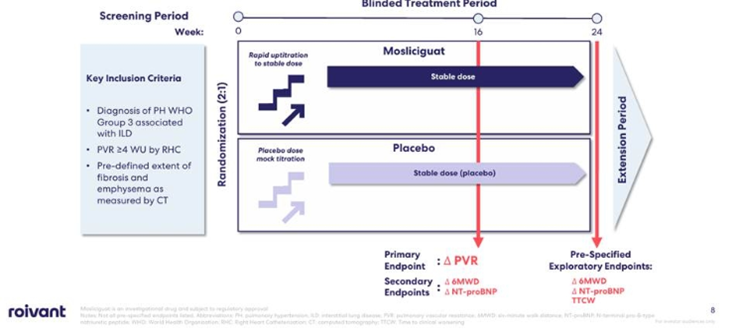
Why these measures matter:
1. Pulmonary vascular resistance (PVR): A 56.3% reduction indicates substantially less resistance to blood flow through the lungs. That could translate into less strain on the heart.
2. Six-minute walk distance: Patients receiving mosliciguat walked an additional 35.2 meters compared with placebo at Week 16, with the difference increasing to 52.7 meters at Week 24. Walking distance is an important measure of functional capacity in pulmonary hypertension.
3. NT-proBNP: This biomarker rises when the heart is under stress. Its substantial reduction provides supporting evidence that the treatment may be reducing cardiac strain.
Additional exploratory measurements showed a 22.8% reduction in mean pulmonary arterial pressure and a 26.2% increase in cardiac output versus placebo.
Taken together, the results suggest an effect on pulmonary circulation that is accompanied by improvements in physical function.

What could make mosliciguat different?
Two possibilities stand out.
Once-daily dosing. Existing inhaled prostacyclin treatments generally require multiple daily administrations. Mosliciguat is delivered through a dry-powder inhaler once per day.
Combination therapy. Mosliciguat activates the sGC pathway, while existing therapies such as treprostinil work through prostacyclin signaling.
Because the mechanisms differ, researchers are investigating whether combining these treatments could provide additional benefits.
For perspective, inhaled treprostinil demonstrated a 31-meter placebo-adjusted improvement in six-minute walk distance at Week 16 in its Phase 3 INCREASE trial, compared with 35.2 meters for mosliciguat in PHocus.

These are separate studies, not a head-to-head comparison. The results cannot establish which treatment is superior.
What still needs to be proven?
The Phase 2 safety profile was generally manageable, although treatment discontinuations were higher with mosliciguat (12.1% versus 4.5% for placebo). Headache, edema and nausea were among the reported adverse events.
Roivant's ongoing Phase 3 PHrontier trial, targeting approximately 375 patients, will evaluate whether the Phase 2 benefits can be replicated in a larger population.
Unlike PHocus, Phase 3 permits background inhaled treprostinil, offering an opportunity to evaluate mosliciguat alongside an established therapy.
The bigger picture
The most interesting aspect of PHocus may not be any single number.
It's the combination of lower pulmonary vascular resistance, improved exercise capacity and reduced cardiac strain, all observed with a once-daily inhaled treatment.
If confirmed in Phase 3, mosliciguat could become another treatment option for patients with PH-ILD, potentially as a standalone therapy or alongside existing medications.
For now, the Phase 2 results provide encouraging clinical evidence — but regulatory approval, long-term safety and the benefits of combination treatment remain unproven.
Source: Roivant Sciences/Pulmovant, PHocus Phase 2 results, September 2026.


Comments